londonhvacpro · Refrigeration & Air Conditioning
Commercial Chiller & Chiller Plant Installation
Chiller installation begins with an agreed cooling duty and a workable system design, not simply a replacement machine selected from a nameplate. Air-cooled and water-cooled chillers reject heat differently, while process cooling may require fluid temperatures, materials and operating hours that differ substantially from comfort cooling.
Engineer labour from £120+VAT/hour · One-hour minimum · Installation, parts and maintenance contracts quoted separately
A useful installation scope defines the load, water circuit, heat rejection, electrical supply, controls, access and commissioning evidence together. Existing plant readings and drawings help establish what can be retained and what needs alteration. Equipment selection and project pricing should follow that assessment rather than an assumption that the old arrangement was correct.
Establishing duty and operating conditions
Determine the actual peak and minimum loads, required leaving and returning fluid temperatures, operating schedule and acceptable temperature variation. Building cooling loads may be seasonal, whereas a manufacturing process can need cooling through winter as well as summer. Process start-up loads, batch changes and equipment shutdown sequences can govern selection more strongly than the normal running duty. Obtain these requirements from the responsible designer and process operator rather than estimating them from floor area alone.
Selection must use the proposed ambient conditions and fluid properties. Glycol changes viscosity, specific heat and heat transfer, affecting both available cooling and pump duty. A nominal rating at standard test conditions is not a promise of performance at a lower fluid temperature or higher outdoor temperature. Check minimum stable loading, permitted operating envelope and turndown, because oversizing can produce short cycling rather than useful resilience. Any standby requirement should be defined explicitly; it is not automatically provided by having multiple compressors.
Air-cooled installation and heat rejection
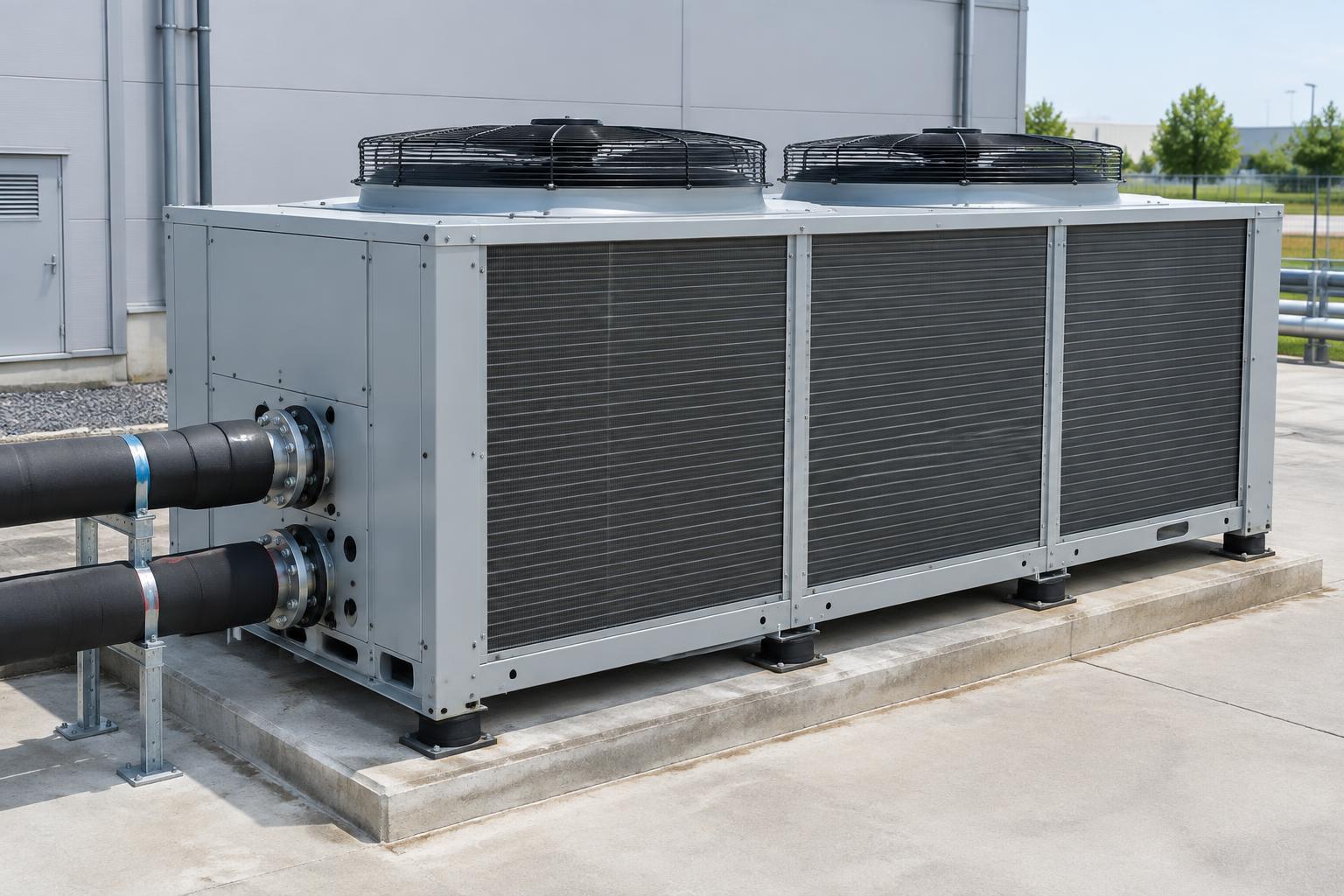
An air-cooled chiller transfers condenser heat directly to outdoor air through coils and fans. Positioning must preserve the manufacturer's service and airflow clearances, including access for cleaning and component removal. Restricted discharge, nearby screens or opposing equipment can allow hot air to recirculate into the coil inlet, increasing condensing pressure and reducing useful output. Acoustic treatment must be assessed alongside airflow rather than added later without checking its pressure and recirculation effects.
A roof or external plant position requires review of structural support, lifting arrangements, vibration transmission, drainage and weather exposure. The design should account for ambient operating limits and any required low-ambient controls. Water pipework exposed outdoors needs a documented freeze-protection strategy appropriate to the fluid and shutdown scenario. Insulation alone delays heat loss; it does not guarantee protection during a prolonged winter shutdown. Lifting, structural work and specialist access should be separately identified within the installation scope.
Water-cooled plant and separate water circuits
A water-cooled chiller has a chilled-water evaporator circuit serving the cooling load and a separate condenser-water circuit carrying rejected heat to a cooling tower or another suitable heat-rejection system. These circuits must not be described as interchangeable. Condenser heat rejection includes the cooling load plus compressor energy, so the heat-rejection design is not based solely on the evaporator cooling duty. Each circuit requires its own design temperatures, flow limits, pressure losses and material compatibility review.
Where a cooling tower is involved, treatment, hygiene management, seasonal operation and responsibility for the tower must be agreed with the relevant specialists and site duty holders. A closed chilled-water circuit has different contamination and treatment issues from an open evaporative condenser-water system. Commissioning records should label both circuits unambiguously. A plate heat exchanger may create an additional separated loop; its approach temperature and pressure loss must be included rather than assuming it transfers heat without penalty.
Hydronic design, controls and commissioning
Pipe sizes, pumps, strainers, air separation, expansion provision and pressurisation should be checked as a complete hydronic system. Available pump head must overcome the real circuit resistance at the required flow. A new chiller connected to a fouled or poorly balanced distribution system can immediately experience low-flow alarms or unstable temperature control. Specify flushing and water-quality acceptance criteria before connecting sensitive heat exchangers, with isolation and accessible strainers arranged for future servicing.
Minimum evaporator flow must be maintained across the intended valve and pump operating range. Variable-flow systems require a compatible control sequence, not merely a variable-speed pump. Buffer volume or hydraulic separation may be needed for stable operation, but the correct arrangement depends on minimum running time, active water volume and load changes. Flow proving, pump enable signals, remote demand, set points, alarm reporting and lead-lag operation should be documented in a controls schedule.
Pre-start checks include electrical protection, phase conditions where applicable, fluid concentration, measured flow and pressure, sensor plausibility and controller settings. Refrigerant work depends on the delivered equipment and manufacturer's procedure; a factory-sealed packaged unit does not automatically require field charging. Commissioning should record water temperatures, flow, ambient or condenser-water conditions, electrical readings and stable operating behaviour. Explain which acceptance tests were possible under the available load and identify any deferred seasonal checks.
Handover and installation pricing
Handover should provide the agreed drawings, equipment information, set points, test results and operational limits. Record isolation points, treatment responsibilities, alarm actions and any outstanding work. Operators need a safe response to flow and freeze alarms, not instructions to repeatedly reset protection. Process installations should also define what happens to the production equipment when cooling is unavailable, including interlocks and a controlled restart sequence agreed with the process owner.
Engineer labour is £120 + VAT per hour with a minimum of one hour. This is a labour charging basis, not an installation price, equipment price or whole-project quotation. Installation cost depends on the selected plant, hydraulic alterations, electrical work, lifting, access, controls integration and commissioning requirements. Parts, equipment and specialist works need an agreed scope and quotation. No output rating, delivery date, available stock or project duration should be inferred without checking the actual requirement.
Chiller engineering questions
Commercial chiller, chilled water and data centre cooling
Engineer labour from £120 + VAT per hour, with a 1-hour minimum. Parts and materials are quoted separately before work begins.