londonhvacpro · Refrigeration & Air Conditioning
Planned Chiller Maintenance & Contracts
Chiller maintenance is a planned assessment of refrigeration performance, heat rejection, hydronic circulation, electrical condition and control reliability. Its purpose is to identify deterioration and correct its causes before a loss of cooling or damage occurs.
Engineer labour from £120+VAT/hour · One-hour minimum · Installation, parts and maintenance contracts quoted separately
Air-cooled, water-cooled and process chillers share some principles but do not have identical checklists or maintenance frequencies. A useful plan follows the manufacturer's requirements, the site's operating conditions and the consequences of failure. Readings should be compared with a documented baseline under comparable conditions, rather than treating a completed checklist as proof that the whole system is healthy.
Intervals based on condition and duty
There is no single service interval suitable for every chiller. Operating hours, ambient contamination, seasonal use, fluid quality, process criticality and previous faults all influence the plan. A coil beside trees or an extract discharge may need inspection more frequently than equipment in a clean location. A continuously loaded production chiller may warrant different monitoring from standby comfort-cooling plant. Statutory refrigerant checks, where applicable, are a separate requirement and must be established from the equipment and current rules.
Build the schedule from manufacturer instructions and an initial condition review. Increase inspections when trends show rapid fouling, recurring strainer blockage, unstable pressure or treatment deterioration. Review the interval after cleaning or remedial work to see whether the underlying cause has been controlled. Operators can record accessible temperatures, alarms and visible leakage within agreed safe limits, while intrusive electrical, refrigeration and pressurised-system tasks belong to appropriately competent personnel. Neither an annual visit nor an arbitrary monthly visit automatically meets every plant's needs.
Air-cooled condenser care
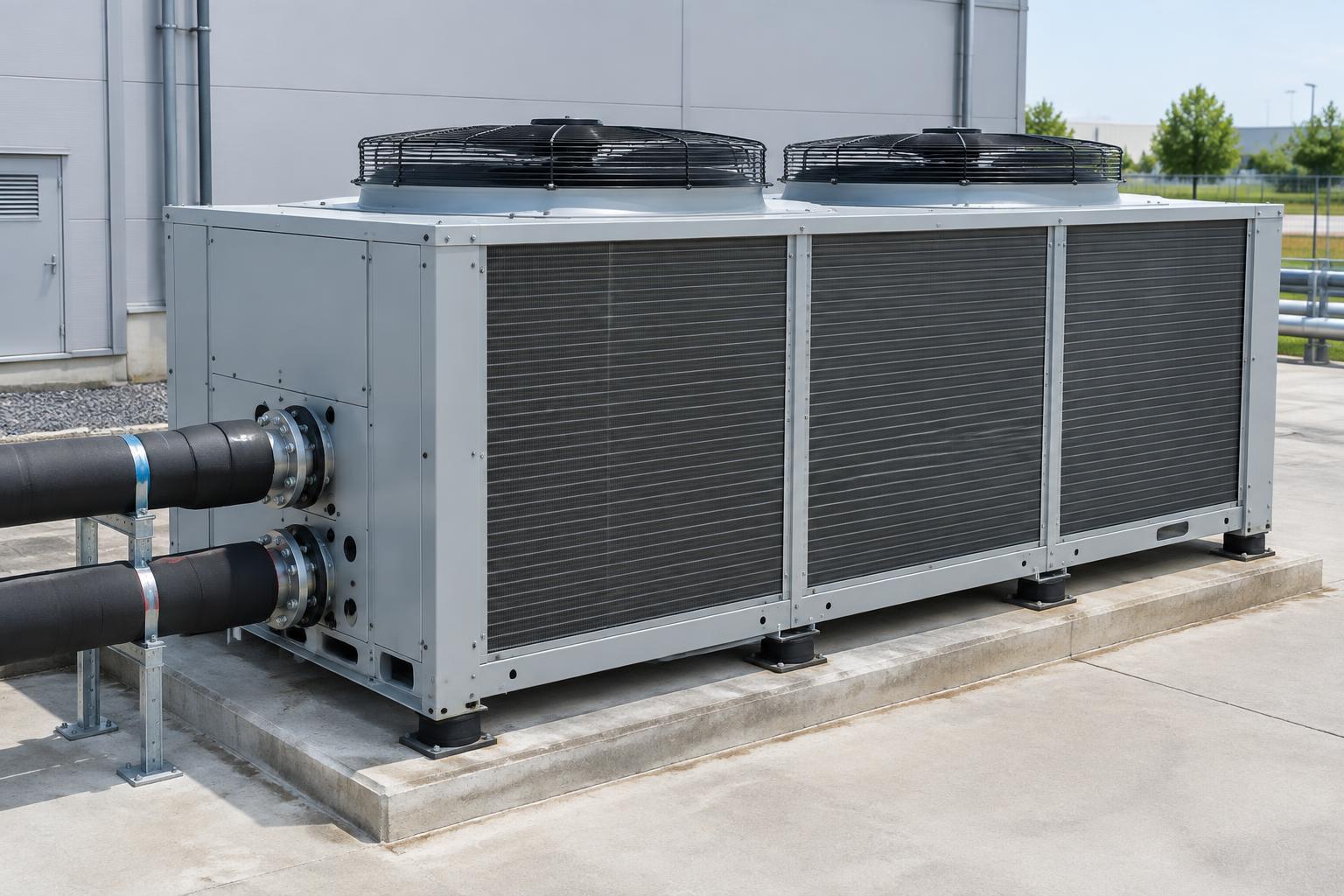
Air-cooled units depend on a clear heat-transfer surface and effective airflow. Check coil condition, obstructions, fan operation and evidence of hot-air recirculation. Compare condensing behaviour with outdoor temperature and load. Higher pressure alone does not prove an incorrect refrigerant charge; a fouled coil, failed fan or restricted air path can produce a similar symptom. Maintenance should distinguish these causes before changing refrigerant quantities or controller settings.
Cleaning method must suit the coil construction and manufacturer guidance. Excessive pressure, unsuitable chemicals or aggressive brushing can damage fins, protective coatings and microchannel surfaces. Isolate equipment safely and protect electrical components. After cleaning, verify airflow and operating response rather than simply recording that the coil looks cleaner. Inspect supports, corrosion, vibration and pipe insulation where accessible. Outdoor water circuits also need a seasonal review of glycol protection, trace heating where fitted and the agreed response to a loss of power.
Water-cooled condensers are not chilled-water evaporators
For a water-cooled chiller, monitor condenser-water entering and leaving temperatures, flow, pressure loss and evidence of tube fouling. Heat rejection may be impaired by the tower, condenser-water pump, valves, strainers or treatment condition rather than by the refrigerant circuit itself. Tower-related work and water hygiene responsibilities should be clearly allocated. A refrigeration maintenance visit must not be represented as automatically covering the whole cooling tower management programme.
The evaporator's chilled-water circuit serves the building or process load and needs a separate record. Its treatment chemistry, expansion arrangements and contamination risks differ from those of an open condenser-water loop. Record which circuit was sampled, cleaned or adjusted. Increasing condenser-water flow does not correct a blocked chilled-water strainer, and changing a chilled-water set point does not restore a fouled condenser. Where an intermediate heat exchanger exists, maintain and trend both sides with their distinct flow and temperature requirements.
Hydronic performance and freeze protection
Check pump duty, differential pressure, valve positions, strainers, air removal and pressurisation against the system design. Air entrainment, cavitation, clogged strainers, bypass leakage and poor balancing can all reduce effective heat transfer. A flow switch proves only its own switching condition; it is not necessarily a calibrated flow measurement. Verify actual flow by an appropriate method when assessing performance or minimum evaporator-flow compliance.
Interpret water temperature difference in context. Low delta T can result from excessive flow, bypass mixing, poor terminal control or low load, while high delta T may accompany inadequate flow or a changing demand. Cooling duty relates to mass flow, specific heat and temperature change; glycol alters those properties. Record fluid type and concentration with the readings. Repeated topping up can dilute inhibitors and antifreeze and can indicate a leak or pressurisation fault that needs investigation rather than routine acceptance.
Freeze protection requires more than a controller set point. Review fluid concentration using a method appropriate to the glycol product, sensor condition, pump interlocks and shutdown behaviour. Excess glycol is not automatically safer overall because it increases viscosity and can reduce heat transfer. Process cooling may operate below ordinary comfort-cooling temperatures and needs specific review of freezing margins, fluid compatibility and minimum flow. Do not weaken safety thresholds to avoid nuisance alarms without establishing the cause.
Refrigeration, electrical trends and reporting
Use pressures and temperatures together, interpreted for the actual refrigerant, operating mode and compressor arrangement. Superheat and subcooling measurements are useful only when taken at suitable points under sufficiently stable conditions. Oil assessment is equipment-specific; not every compressor provides the same accessible checks. Investigate signs of leakage rather than assuming that periodic refrigerant additions form an acceptable maintenance routine. Any work involving opening the circuit needs the applicable safe and compliant procedure.
Electrical assessment can include supply condition, current balance where relevant, contactors, protective devices, drives and abnormal heating, subject to safe isolation and suitable test methods. Controller histories can reveal short cycling, repeated trips or conflicting BMS commands. Verify temperature sensors against a suitable reference before compensating for a suspected fault with parameter changes. Safety testing must follow a controlled method that does not expose the evaporator or compressor to damaging conditions.
A useful report records asset identity, operating conditions, measured values, defects and priorities. Distinguish observations from confirmed diagnoses and list any inaccessible or untested items. Explain which work can be planned and which condition requires restriction or shutdown. Labour is £120 + VAT per hour with a minimum of one hour; that is not a fixed maintenance-contract price or an installation price. Cleaning, replacement parts, specialist treatment and further diagnostic work should have an agreed scope rather than being implied as included.
Chiller engineering questions
Commercial chiller, chilled water and data centre cooling
Engineer labour from £120 + VAT per hour, with a 1-hour minimum. Parts and materials are quoted separately before work begins.